

Caracol Dos Profetas
The Voice of the Earth, Chiseled by the Wind

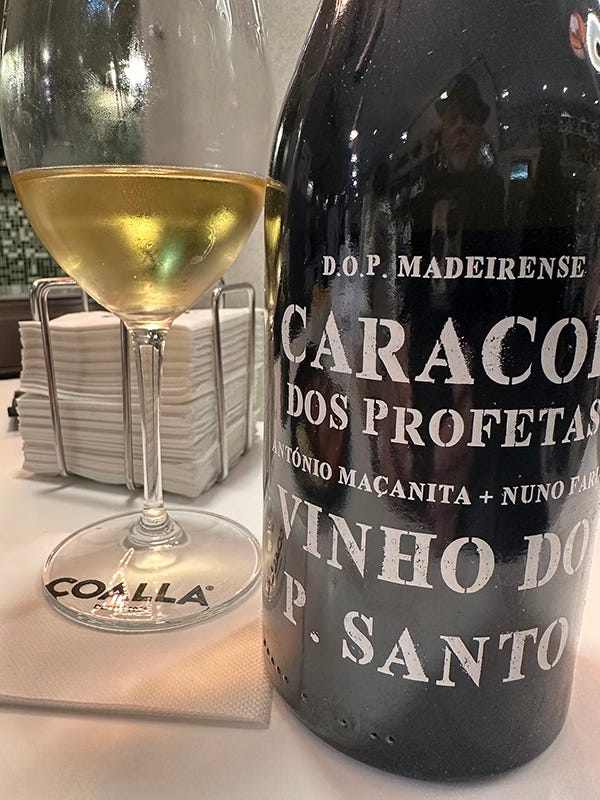
Picture an island adrift in the Atlantic, a mere speck on the crepuscular edge of Portugal’s dominion, discovered by accident in 1418 when sailors, blown off course, stumbled onto its desolate shores. They could not have known this chance landing would rewrite their maps, revise their myths.
This was Porto Santo. The quiet sibling of Madeira; wind-scoured, parched, shaped by forces indifferent to human ambition. Here, survival is less a condition than an argument, waged against the wind, the salt, the slow erosion of time. And yet, improbably, Caracol dos Profetas is born: a white wine luminous as the horizon, as unlikely as the vineyard that yields it.
António Maçanita is a winemaker with the instincts of a gambler, which is to say, a belief in risk as the price of revelation. Nuno Faria, a Michelin-starred restaurateur, holds a dream with the same conviction he holds a knife, deftly, without hesitation. The two of them, perhaps drunk on ambition or the sheer madness of reclamation, surveyed Porto Santo’s battered vineyards, less than 14 hectares, vines averaging 80 years—and saw not ruin, but a wager worth making. A resurrection. A chance to wrest something extraordinary from the edge of the impossible.
The grape in question is called Caracol, an enigmatic variety with a name that suggests something small and unassuming, though its origins are anything but. Local legends—because every ancient grape needs one—claim a mythical Mr. Caracol brought it to Porto Santo, a tale so absurd it feels like a prank played by the present on the past (or, as some might call it, science fiction).
Yet myths like these tend to endure in viticulture, not merely for their charm but because they serve a purpose: they anchor a grape’s identity in something timeless, almost sacred. These stories become a way for a place to claim its grape as uniquely its own, weaving history, culture, and a touch of whimsy into the fabric of its vineyards. After all, vines thrive not just in soil but in the imaginations of those who tend them.
See, that’s the thing about windswept islands: veracity gets folded into a narrative that constantly evolves. People come and go. Different versions of the same stories emerge—as if conjured from the ether, brought in by the wind itself, from far-flung places, other lands, where other stories are playing out.
If myths anchor a grape’s identity in the sacred, science roots it in the tangible. Actual Science, less fanciful but equally intrigued, links Caracol to the Listrão grape, their tangled but ancient lineage echoing the windswept resilience of Porto Santo itself. And in hushed tones carried on the wind, there are faint stories of vines brought from Cyprus and Greece by the first Portuguese settlers, heard once, or perhaps imagined by someone, then repeated, until the whispers became part of the island’s very fabric, part of the culture of the place, inseparable from its identity.
‘Caracol,’ incidentally, is also the name for the thousands of sea snails dotting the island’s coast (and all the other coasts in Latin America, as the same word is used in Spanish). Think of it this way: the Nautilus is the original Caracol shape. And, according to a recent study conducted by the Department of Sweeping Assumptions, I’ll suggest that the name of the grape is inspired by the spiral-like shape in which the vines are trained, both to protect the grapes from gale-force winds and to keep them low to the ground.
Geneticists, less whimsical but equally intrigued, link Caracol to the Listrão grape —also known as ‘Palomino’— grown in the Canary Islands and, in another variation, in Jerez, Spain. It’s as if the vines themselves murmur, ‘We are one, and we are ancient.’
Regardless of its origin, growing here is an act of defiance. The soil is skeletal—limestone with a sandy loam texture (pH>8.5), highly alkaline, forcing the vines to struggle, producing smaller berries with tremendous concentration. Meanwhile, rain is scarce, and the Atlantic wind as harsh as a spurned lover is cruel. The vines crouch low, hugging the ground in self-defense, encircled by stone walls that feel equal parts protective and funereal. Yet this battered land, born 14 million years ago, yields grapes so singular they demand their own mythology.
The process of winemaking here is predominantly intuitive rather than paint-by-numbers clinical, like musicians who ‘feel’ their way through the piece they're performing, rather than stick to every dotted quarter note. António Maçanita embraces the unruly nature of the land and the grape, allowing a natural, almost wild fermentation to unfold. Grapes are hand-harvested, pressed whole, and left to ferment without the usual intervention of sulphur dioxide. The must oxidises and evolves freely—unchaperoned, as it were. No use of SO2 until the end of fermentation.
Afterward, the wine rests on its lees for eleven months (!) in barrels of 228L and horizontal stainless steel tanks of 250L to 1000L, their sleek, futuristic forms striking an anachronistic contrast to the island’s barren, prehistoric landscape. Ultimately, it is time—and the skin contact—that lends texture and complexity to the wine, weaving together its final story.
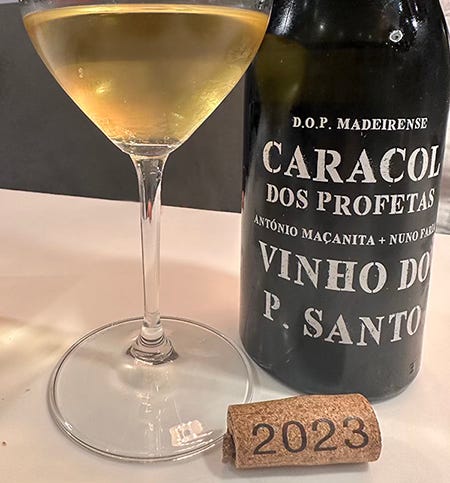
And this is where the soul of the winemaker emerges in the final product. Dos Profetas Caracol is, indeed, a soulful wine, one with a distinct identity, anchored in its place and the specific timeframe of its creation, the year it was made. When winemakers (also, cooks, musicians, writers…) refuse to follow a “Standard operational procedure” template and instead trust their instincts, they create an opening in the cosmos for their intent to manifest. Their spirit of the terroir and the varietal in question (Caracol, in this case) imbues the work, showing through like light illuminating stained glass. Each bottle of Dos Profetas thus carries an imprimatur, a unique stamp of personality and individualism, like a messenger from a distant land.
Which is exactly what this wine is: a message in a bottle.
“We are ancient. We are one.”
The result? A stately wine that speaks with quiet authority, its deep golden hue eliciting a nose of flowers, lashings of dried apricot, whispers of gunpowder (courtesy of the volcanic soil), and sea spray. On the palate, it is all weighty freshness and racy nerve, like a slightly twitchy thoroughbred, with just enough acidity to give it a spine, and perhaps bite a smart remark at the right moment. There’s more, of course, though still in inchoate form. You taste not just the grape, but the vineyard itself; its struggle, its resilience.
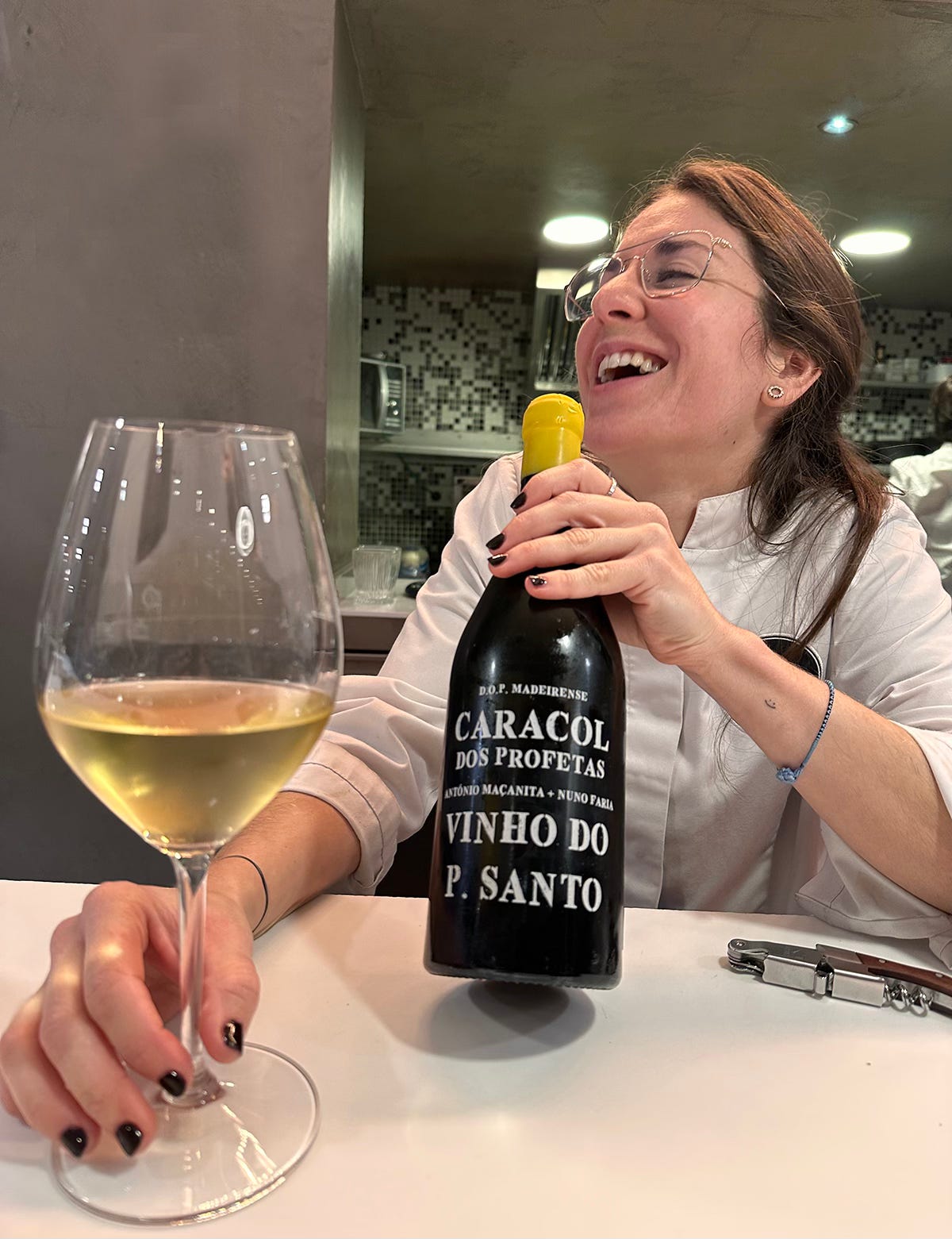
Andrea ‘de La Fontaine’ — oenologist and sommelier; Coalla Gourmet, Gijón, Asturias
But Caracol dos Profetas is more than just another exotic curiosity. It is a refusal. A refusal to disappear. A declaration that even the smallest, most wind-tossed places can still conjure greatness. It is a wine that argues against mediocrity and slow forgetting. Creamy and crisp in equal measure, it belongs to its place so completely that it could not come from anywhere else.
It joins a rarefied company. Wines like Clos de Mont Luisants from Domaine Ponsot, or Valentini’s Trebbiano d’Abruzzo. Wines whose profiles seem carved from mineral and memory. Wines that feel sculpted, not grown. Michelangelo’s unfinished Slaves come to mind, figures emerging from stone, still bound but straining toward form. Making wine here can feel like that. A solitary struggle to coax spirit from matter.
Caracol dos Profetas is the taste of an island that refuses to recede. A place that has decided it will not be forgotten. A wine that leaves no room for nostalgia, because no one will feel the need to say, Antigamente, as coisas eram diferentes. (“Back in the day, things were different.”)
Because now, they are not.🥂

OK, going to go out and try this one and then pretend I went there.